Wonderment S1E6 - Wrong Route to Redress
The western road, just past the tower, bore evidence of its previous victims. Deep ruts from cartwheels sliced the mud into something geometric. Hoof prints made Wonderment question their decision to leave the horses behind. They’d elected to bring a single cart with provisions, pulled by a mule. On their right, a crumbling stone wall guarded against a rocky descent into a ravine. Dry wind rasped through the sky like a death rattle, and they all did their best to shield their noses and mouths with what bits of fabric they carried. Wonderment tied a faintly perfumed scarf around his face: burnt sage and lilac. As they carried on, the mud turned to cracked dirt with small clumps of grass; only the grass looked scorched. There were several trees, even in this rocky terrain, great fractal formations of branches without leaves. Then, all traces of life vanished from the landscape.
At a ridge’s crest, they glimpsed the thatched roofs of a village below, and for one foolish moment their spirits rose. Charles quickened his pace; surely his men had earned a bit of rest. They hurried on, eager for any sign that human life was still permitted in that inhospitable country. Their hopes faded. No smoke rose from the chimneys. The streets were empty. Several of the dwellings had been reduced to rubble, as though they’d been smashed from above by massive falling boulders, or perhaps a giant’s cudgel. Just before the town, there was a short sign that read, “Forgiveness. Est. 1405.”
Solemnity fell over the group as they passed through the abandoned square. The well was dry, and no one suggested stopping. Some terrible emptiness kept them marching until the trail rose steeply again. The mountains ahead were monstrous things, the color of dry clay, their jagged peaks like the fangs of a buried predator. Every so often, there were trail markers resembling saints, but they were crudely carved, and their features were blurred. At each of these statues, crows perched on their shoulders or at the tip of their staves. No one even noticed the birds at first, but by the third statue, the crow perched there seemed less like decoration than like a companion to the decaying figure. More worrying still, the crow did not stir as they passed. It watched.
Wonderment was the first to register the whole scene as inherently disturbing. This landscape, these statues, the birds themselves – none of this could be real. It belonged to story and rumor, the sort of tales adults invented to make children behave. His gaze kept darting from one rock formation to the next, like a field mouse that knows a hawk is near. Rafferty, meanwhile, checked on the other men. He asked to inspect the soles of their boots. He hefted the waterskins, measuring what remained by weight. Too many were filled with wine. At last, he said to Wonderment, “I don’t like it here.”
“Nor do I,” Wonderment admitted. “There isn’t much we can do except keep going.”
Upon seeing the fourth statue, adorned with three crows, Charles allowed his unease to boil over.
“Don’t you know who I am?” Charles roared. “Don’t you know what was taken from me?”
Cold, beady eyes appraised him with equal parts hunger and indifference. Charles plucked a shard of rock from the ground and hurled it in their direction. It clattered into the dirt, falling short of the statue. The crows did not move. Absentmindedly, Charles reached for his crown, long since removed, as if to straighten it after his efforts. By then, the climb had set a steady fire in their calves. The trail ascended, disappearing into a ridge where the peaks of several rock formations suggested the path had been consumed, as if they were being led into the lower jaw of a massive beast. Along both sides of the trail stood rows of uniform stones, oddly regular in that savage place. Their tops were covered in bright crimson. Rafferty dragged a hand across the top of one stone, which was unusually flat. His palm came away wet, coated in red.
“Wonderment,” he said, his voice gravelly. “You know what these are?”
Wonderment sighed. He tried not to count them. He doubted he could count them all; they were so numerous.
At last, they reached the other side of the rise, and an arid plain stretched before them. Wind whipped across the cracked ground, lofting huge clouds of dust that obscured what lay beyond. There, the road split into three directions. Just before the junction, a weathered black stone rose, its height that of a man. On its surface, there was writing in white chalk. For each route, there was an arrow. An inscription next to the leftward-facing arrow read: TO THE FALLEN. The center arrow, pointing directly ahead, read: TO THE WORTHY. The final arrow, rightward, was labeled: TO THOSE SEEKING REDRESS.
“Whatever happened to Oxfordshire, Glasgow, hell, even New York?” Wonderment asked aloud.
No one responded at first. Charles read the directions several times, placing his finger beneath each letter, as though he couldn’t get them inside his head.
“The answer is clear, lads,” Charles said. “My treasure has been stolen. My right to govern has been insulted. And, perhaps worst of all, there weren’t enough doves earlier!”
Charles headed to the right without giving anyone else a chance to comment.
“Fine,” said Rafferty. “The signs around here are useless anyway.”
The road narrowed between brambles and wicked thorns. Every so often, a thorn branch would stretch across the trail, impossible to avoid. A traveler would carefully lift it out of their way, only for it to swing back violently and lash the man behind. The horizon vanished, replaced by an ever-flowing wall of lofted dust. Nothing broke the monotony of the road except the shrines, which rose at intervals like petty lawsuits in stone. At each shrine, in carved lettering, was a description of some grievance. The first shrine they stopped at read: MY WIFE CHEATED ON ME WITH A BLACKSMITH. A long-molded piece of bread had been left at the foot of the shrine, presumably as an offering.
A bit further on, the path bifurcated again. This time, the lettering on the wooden arrows of the sign appeared to have been burnt into the wood. The left arrow read: PETTY SQUABBLES, while the right read: SUBSTANTIVE INJURY; NOT FOR MERE OFFENSE. Charles’s choice was obvious. The right-hand path was paved in crushed shell, splintered yet hard as stone. Rafferty noticed at once that the shells were cutting small gashes in their boots and embedding themselves in the leather. Within miles, he knew, their soles would be cut clean through. At another of these shrines, Charles found a single rusted spur left as an offering beneath the inscription: A RIVAL CHEATED ME OUT OF MY INHERITANCE. The words struck him with humiliating intimacy; they seemed carved for his benefit alone. Charles pocketed the spur. Inside the shrine stood a small statuette of a grizzled man leaning on a walking stick and wearing a crown of thorns. Instinctively, he reached for his own crown, but it wasn’t there to straighten.
While he walked, the spur in his pocket jabbed him in the thigh. He tried adjusting it, but to no avail. However he shifted it, the thing kept finding flesh, yet he could not bring himself to throw it away. On they marched, stopping only to read the shrines and the grievances that led others down the same road. The stops were a welcome break from the tips of the shells, which had started to work their way through the soles of their boots, pricking and prodding with each step.
“Didn’t we already see this guy?” asked Wonderment. He was leaning down, looking at a statuette of a saint inside a shrine.
“No,” replied Charles as he pressed on, scarcely looking. “The one before had fewer thorns in his crown.”
“Wonderment,” Rafferty whispered. “That’s the same statue. We’re looping.”
“I know,” Wonderment said under his breath. “Let’s just see how long it takes that fool to realize it. I’ve seen that statue three times already.”
“There aren’t even any corners,” Rafferty protested. “How could we be looping?”
“I think it’s testing whether we’re stupid enough to keep going,” Wonderment answered.
“Let’s just wait here,” Rafferty said.
They stood off to the side and let the rest of the troop follow Charles, watching as they disappeared into the distance. Just as their silhouettes melted into the clouds of dust, Rafferty chuckled. Wonderment looked and saw that a new set of silhouettes had materialized down the road in the opposite direction. Slowly, the figures drew nearer. When Wonderment was sure he was seeing Charles approaching, he said to Rafferty, “You know, I actually kind of like this place.”
“You do?” Rafferty said incredulously.
“Yeah,” Wonderment replied. “For those seeking redress. The trick is that they never stop seeking. It must be some kind of lesson.”
Rafferty let out a single laugh. “Hell,” he said, “I don’t get it.”
Charles was limping when he approached.
“Wonderment, Rafferty, how did you get so far ahead?” he asked.
They both stared at him.
“What?” he asked.
“You wanna take another lap, or…” Rafferty asked.
When they retraced the road of redress, it disgorged them almost at once into a grassy meadow. The softness of the grass announced itself through its sharp contrast with the road of shells, and Rafferty began picking flakes out of the soles of his boots, never taking his eyes off the tree line. Above them, an expanse of light blue sky was dotted with lazy white clouds. Birds flitted by and perched in the treetops, twittering happily. Wonderment felt uneasy. The normality of this place unsettled him more than any visible threat could have. They rested for a time, or rather, everyone except for Charles rested. He sat on the grass, hugging his knees into his chest, gazing off into the trees.
“How are you holdin’ up, buddy?” Wonderment asked, sitting down beside Charles and patting his shoulder.
“My feet hurt,” Charles said bluntly. “And those trees over there. They’re making me feel… self-conscious.”
Wonderment looked over. He didn’t detect anything exceptional about the trees.
“We should head out soon,” Charles added. “The sooner we’re away from those trees, the better.”
Before long, they were ready to set out again. Rafferty surveyed their provisions cart. They’d already gone through a considerable portion of their water reserves. If they kept up at this rate, Rafferty realized, he’d need to start rationing.
The group moved more slowly now. No one except Charles wanted to leave the glen, with its sunshine and gentle breeze. Beyond the tree line, there was no path at all. Crossing the threshold of the woods, they were thrown into gloom. Overhead, a thick canopy blotted out the light, and what little filtered through was stained a dark green. The forest floor was clear, save for a layer of freshly fallen leaves. The trunks stood just far enough apart that a path might have run between any two of them. Sound was suddenly dampened, absent, the only note a small branch falling from a tree. It wasn’t particularly mystical, definitely not haunted. It was more as though they had entered a room where a conversation had just stopped. Stranger than the hush were the faces carved into the trees. This was exactly the sort of detail Wonderment should have noticed at once, yet the very mundanity of the faces let them slip past his notice. They weren’t the least bit exaggerated or artistic. No fangs nor horns. Not even overly bushy eyebrows. Just regular faces watching from burls and low-hanging branches, trunks, and surfacing roots. Some of these carvings were half-worn off, as though they were very old, but others were clearly new, fresh sap still dripping from their cuts.
“Looks like we’ve got company,” Charles said mockingly. “Hello there!”
There was no reply, only wind in the trees. The gusts made the limbs sway, and for the first time, they all noticed faded banners of various colors hanging from the limbs. Several were ancient, faded, and threadbare. Others looked as though they were dyed yesterday.
“This feels… sacred,” Wonderment said. “I’m not sure we should be here.”
“Nonsense,” replied Charles. He tore a strip of fabric from one of his sleeves.
“Sir Rolland,” he yelled. “Scurry up one of these trees and hang this offering.”
Sir Rolland grumbled. He took the fabric from Charles and stalked away.
“Say, Wonderment,” Charles said. “Do my eyes deceive, or is that a stone arch over yonder?”
He gestured forward, where indeed, through the gaps in the trees, Wonderment discerned the curve of a stone arch.
“What’s that doing way out here?” Wonderment asked.
It looked smaller up close, but it was obviously old. The stones had been wrapped in wire, but the wire had long since rusted. A multitude of small bells hung from the wire, along with little humanoid figures made from straw and twine. Standing before the arch, Wonderment had the unpleasant certainty of being judged. Behind him, the faces carved into the trees seemed to face him, their presence not exactly sinister, more akin to a group of gossipy villagers watching through half-drawn blinds. Beneath the arch was an inscription: STATE PLAINLY WHAT BRINGS YOU FORWARD. Each member of the party read silently, except for Sir Bartholomew, who couldn’t read. He gave the sign a crisp salute. Charles glanced at Wonderment. Wonderment shrugged and turned to Rafferty.
“Well, go on then,” Rafferty said.
“I don’t want to give the wrong answer,” Charles muttered.
At that exchange, the bells gave a soft, interested jingle. Wonderment imagined the carved faces leaned in closer, but ever so slightly. The woods beyond the arch seemed to tremble. The light shifted, but in a way that was barely perceptible.
“Say something else,” Wonderment said.
“Very well,” replied Charles. He straightened his cloak and again reached for the spot where the crown had once sat. It pained him to have left it at the castle. He stepped forward.
“It is I,” he practically shouted. “A king. Wronged. Robbed. I bring these men forward on a great quest of restitution. Justice demands that I….”
Before he could finish, the old mule pulling their provisions cart emitted a thunderous fart.
“I… uhm…” Charles stammered. His gaze dropped to the ground.
The bells adorning the arch began to respond. They swayed back and forth as though catching a nonexistent breeze, tinkling out a jig-like tune that was somehow forlorn. Beyond the arch, the ground began to rearrange itself. Trees vanished. Rocks disappeared. In their place, shards of glass pierced the ground. Outside of the arch, everything remained as it had been; only by looking through could they see the new geography. The glass kept rising and knitting itself together until a sheer reflective wall stood just shy of the arch. Their reflections stared back at them. All of them appeared much as they imagined themselves: Rafferty tall and strong, Wonderment wiry, Sir Bartholomew bandaged about the head. Only Charles was distorted. He appeared short, far shorter than he believed himself to be.
“Well, that’s a bit biased,” he muttered.
“That’s no path at all,” said Wonderment. He thought about that for a moment.
“Agreed,” said Rafferty flatly. “Wonderment. You try.”
Wonderment thought about protesting, but just for a moment. He was curious to see what the arch would reveal, so he stepped forward.
“Uhm… hello,” he began. “My name’s Wonderment. I was the 2017-2018 pachinko world champion. I’m looking for the author. I don’t know much about him, but he seems to keep cooking up these… they’re sort of like fake realities… then I get hopelessly stuck in them. I’d like to find the guy and… sort some things out with him.”
It was as though the forest itself gasped. The glass shattered to reveal a path toward the mountains, but almost at once the ground beneath that path fell away into a great chasm. An insidious gust shook the treetops, and the bells jangled angrily. Then a great squawking arose. Hundreds of birds, unseen until now, took flight all around them. Every bird simultaneously voided itself.
“Oh,” said Wonderment. “Terribly sorry. Strike that.”
Rafferty stepped forward. “Some men who need water and a road that goes forward.”
The clamor died down, and the arch gave a low groan. Beyond, a path formed, one that led through a marshy field with sparse tree cover.
“Shall we?” Rafferty asked.
Charles merely scowled and scuffed at the earth like a rebuked child.
Rafferty stepped first through the arch. The others followed, if a bit reluctantly. The field they had stepped into was sulfurous and rank, smelling like old socks and bad hell. Their scraped boots sank into the mud, but they moved forward, nonetheless. The path was narrow, and the landscape was dotted by murky pools. A single misplaced footfall sent their feet sliding sideways down greasy embankments and into shin-high sludge. To make matters worse, the sun beat down on them through a thin gray haze. Rafferty felt personally offended by their situation. The water in the pools couldn’t possibly be potable. He stationed himself as a guard by their provisions wagon and measured how much the men drank. “Two gulps, nothing more for now!”
When Wonderment came for water, Rafferty spared him the barked ration and simply handed him the skin. He said, “I don’t want to die out here, Wonderment.”
Wonderment chuckled. “You’re not going to back out before Charles, are you?” he teased.
Charles shot accusing glances at his companions and spat in the pools. “Unbelievable,” he shouted at nothing specific. “Road to redress my royal behind.”
Wonderment kept falling out of the moment. His thoughts developed blank seams, and his gaze lingered too long on the horizon. Once, he caught himself humming the jingle of a bottled water advertisement he’d seen years before. “Do do do do do… Aqua Cola! Drink it!”
Then he heard it: a low mechanical thrum, too steady to be hoofbeats and too ugly to be wind. He looked around but couldn’t see anything. The sound grew louder. It was grinding – a kind of humming.
“Does anyone hear that?” he asked.
Charles shot him with an icy glare and muttered something about heatstroke.
Then Wonderment saw something peculiar. Off in the distance, a dull light was moving along a high spot in the marsh. It was blinding. He kept his eye on it as the party drifted toward it. A short while later, he saw that the light was actually reflected sunlight, caught by an object of metal and glass. He glimpsed the number 47 illuminated in orange neon.
“What the hell is that?” he asked. “Can anyone else see it?”
He began to rush ahead.
Charles called to him, “Wonderment! What are you doing?”
Wonderment scaled an embankment ahead of the group, his feet freeing dirt clods that rolled down the slope behind him. When he saw the thing in its fullness, he was dumbstruck. Moving toward him was the Route 47 commuter bus.
“Guys, it’s a bus,” Wonderment called down to them.
“I don’t see anything,” Charles barked.
Sir Rolland yelled, “What’s a bus?”
“Where?” called Rafferty.
“Come up here!”
Rafferty scrambled up the embankment. “Uh… yes,” he said. “That is certainly a bus.”
Wonderment stretched out his arm and waved. The bus’s brakes screeched and hissed as it pulled to a stop in front of him. The other nobles, having never seen a bus, began to panic.
“What is that contraption?” Sir Bartholomew cried. “Protect the king!”
He tried to charge ahead but fell face-first into the mud.
“Your majesty, flee!” Rolland yelled. He drew a sword and ran to Charles’s side.
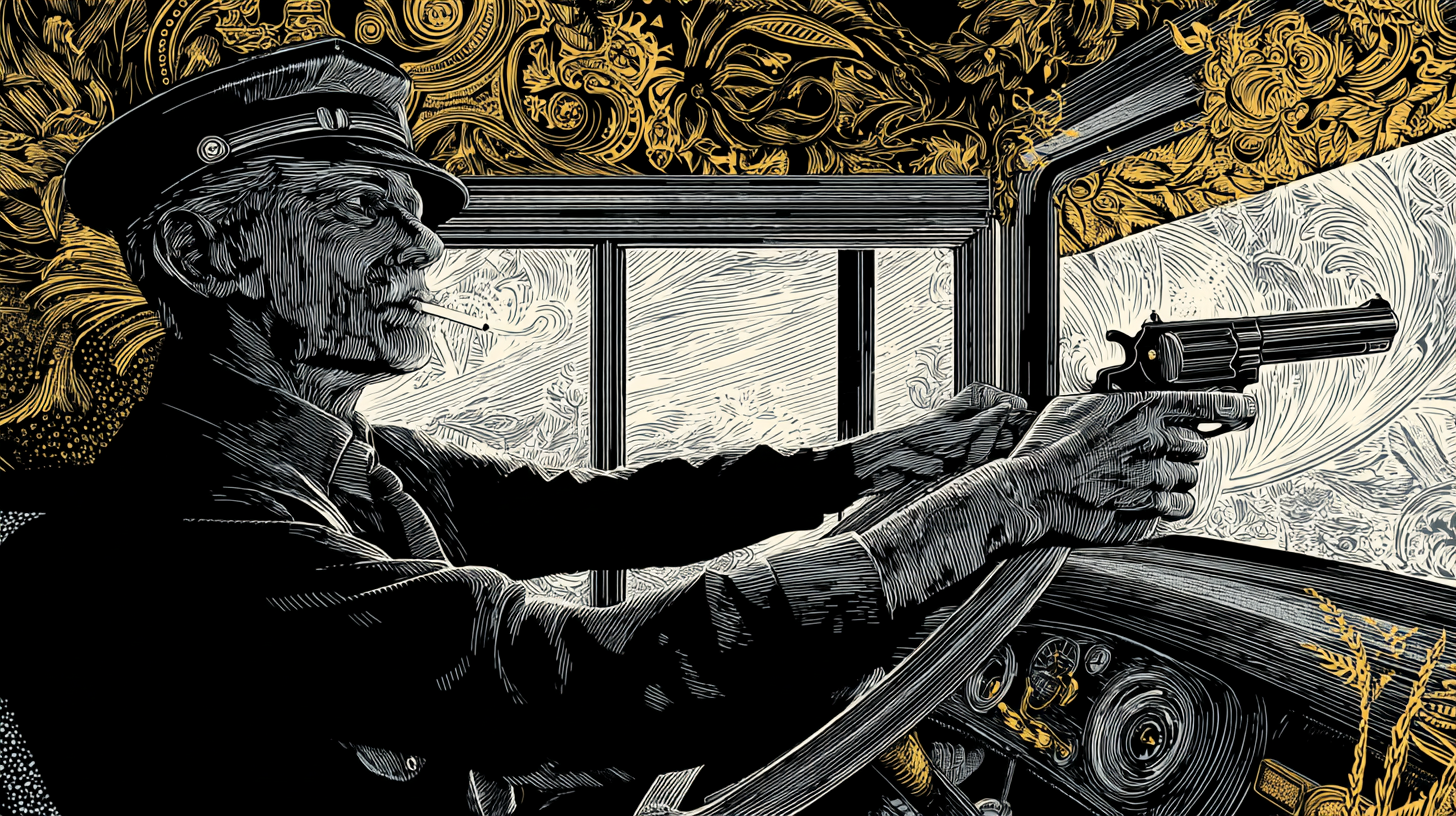
Charles stood in shock, not quite believing what he was seeing. The knights moved into a protective chevron formation before Charles, their blades raised. The folding door slid open, revealing a man in a pressed uniform and cap, his collar impossibly crisp, his expression bored, even as armored men came clattering up the embankment toward him.
“Call them off, Charles,” Rafferty roared.
“Oh, right,” Charles said, as though waking up, “Men! Stop! Lower your weapons!”
They obeyed his command, but they didn’t relax their grip on their weapons.
“Just a minute, please,” Wonderment said to the bus driver. The man glowered at him, rolled his eyes, and adjusted a small circular fan so it pointed more directly at his face.
“You coming or not?” the bus driver yelled down at them.
“Yes, yes, hold on,” Wonderment said. Turning to Rafferty, he said, “Do something.”
Rafferty began ordering the knights to unload their remaining supplies. The knights immediately began arguing. The bus driver watched with bored amusement as they unstrapped gear from the wagon, Rafferty directing the chaos like a quartermaster.
As if to add to the confusion, the bus driver called, “You’re not bringing that muddy armor on my bus!”
The knights began to awkwardly disassemble their armor. Metal breastplates snagged against greaves. Swords were dropped. Provisions were frantically sorted. When they were only halfway ready, Charles stepped aboard.
“Where to?” the bus driver asked as though the effort pained him.
“Author’s Kingdom,” he replied.
“That’ll be $5.95,” the bus driver said. “Exact change only.”
Rafferty muttered something about fiscal inflation.
Charles fished around in his pocket, adjusted the spur, and retrieved a large gold coin imprinted with his likeness. The bus driver snatched it from him, inspected it, and then slipped it into his pocket, obviously avoiding the till. Then, he stamped Charles’s hand with red ink. The stamp read “LOSER,” and it persisted for exactly 3 seconds before vanishing.
“Alright, you’re the claimant pursuing vindication,” the bus driver said, “Seat 12.”
Wonderment went next. He received a different stamp but didn’t bother to read it.
“You’re the one with all the author nonsense, seat 13.”
Rafferty followed.
“Seat 14. No eating or drinking on the bus.”
The others were classified in a similar fashion and took their seats, completely unsure how to act. A small plastic plaque affixed to the back of each seat read: 1. Sit, 2. Do not speak to the driver. That thin barrier between driver and passengers was enough to make them feel processed rather than conveyed. Sticky vinyl seats and scratched windows were at once intimately familiar to Wonderment, yet so devoid of reality that it made his head spin. Rafferty sat with his sword across his lap like a bag of golf clubs. The air was warm, and it smelled recycled, as though it had already been breathed several times and its oxygen content was beginning to dip. The bus trundled off along the dusty road, and Wonderment tried to watch the scenery. Yet all he saw in the glass was his own reflection – not a knight or a wanderer, but a tired commuter, a man from the wrong life. His reflection sickened him precisely because there was nothing overtly wrong with it. He fought to hold back tears.
The hum of the engine lulled Wonderment into a trance. Then it gave him a headache. A rattle from a nearby window sent pangs through his skull. He tried to relax, but when he did, his mind demanded focus. Whenever he fixed on something outside, his mind whitened around it and slipped away. Eventually, he looked at the other passengers. A few rows ahead, a gray-haired woman was arranging scrolls on the seat next to her. After poring over one scroll, she rolled it back up as tightly as she could. Then she’d inspect the red wax seal, running her fingertip over its imprinted surface, as though surprised it was broken. She wore the exhausted intensity of someone still arguing her case in her head. Wonderment noticed that Charles was studying the same woman and wore the same exhausted expression she did.
Another rider, nearer the front, wore immaculately clean white robes and a gold chain about his neck. From the chain hung a circular pendant with an emblem that Wonderment didn’t recognize, but every few moments, the man would raise it to his forehead, eyes closed, lips moving through a soundless prayer. His posture was rigid, and though he couldn’t be sure, Wonderment supposed the man thought a great deal of himself. Further back was another man wearing tattered robes. He stared straight ahead, his head slightly bowed, as though his gaze might drill straight through the seat in front of him. In the seat next to him was a fiddle with a badly warped neck and two strings. Directly across from Wonderment sat a woman who seemed normal in every conceivable way, except for a faintly confused expression, as though she were always on the verge of asking a question.
Wonderment began to imagine the stories of these individuals and the roads that must have led them here. The older woman with the scrolls was clearly sorting through a messy, high-stakes inheritance snafu. The saintly man looked born to privilege; the absolute lack of calluses on his hands was evidence enough. If any were fit to walk the path of the worthy, it was he. The woman across from him unsettled him most. His mind wasn’t able to conjure her story. Perhaps she was just heading home from work. She coughed, shielding it with her elbow. Charles surveyed the other passengers and saw only a court that had failed to present itself. He was a bit surprised they hadn’t crowded around him, whether to seek his favor or beg forgiveness for some error in their ways. Their indifference stung him; they would not spare him so much as a glance. His hand wandered to his temple. Only the woman with the scrolls looked in his direction, her smile feeble.
“Hello there,” Charles said.
“Hello,” she replied.
Rafferty tried asking the man with the fiddle if there were frequent stops. The man shrugged.
“Are you doing alright, Sir Bartholomew?” he asked.
Sir Bartholomew gave him a toothy grin and then turned to salute a passing road sign.
“Where can we get water?” Rafferty shouted so the bus driver would hear him.
“There’s no eating or drinking on the bus,” the bus driver shouted back. “And no talking to the driver!”
Rafferty leaned back, annoyed.
The sheer banality of the commute unsettled Wonderment; it fascinated him even as it made him homesick.
Sir Bartholomew abruptly stood and, enunciating with great care, shouted, “I just want to state, as a matter of record, that I am grateful for this opportunity to serve my king and country!”
Wonderment and Rafferty turned back to look at him. Charles did not.
“It’s a fine thing to give one’s toil for the good of the nation,” Sir Bartholomew continued.
“Sit down!” The bus driver yelled.
None of them knew how much time had passed. It felt like hours, but the sun remained motionless in the sky. Then the bus’s brakes squealed.
“Seat 7, next stop only, Affidavits and Regrets,” the bus driver called.
The woman gathered her scrolls in her arms, barely able to manage them all, and she departed.
A short time later, the bus driver called, “Seat 4. Revelatory Authorizations.” The man in the extraordinarily clean robes got off, kissing his pendant one last time as he did.
Sir Rolland, seated near Rafferty, became chatty. “I tell you, Sir Rafferty,” he droned, “this must be the strangest thing I’ve ever seen, and I once seen me grandmum eat two bushels of raspberries in one sitting. I tell ya, when she was done, you’d’a thought she butchered a hog.”
“Is that right?” Charles asked from behind, chuckling.
“Alright,” the bus driver called, “Seats 12, 13, and 14. Next stop!”
Wonderment swung around to face the window, desperate for some hint about where they had ended up. He saw nothing out of the ordinary. The only thing he could tell for certain was that the bus was running high through mountainous country. There appeared to be a valley on one side, and on the other, mountains and snow just a short distance away. The bus’s brakes hissed once again, and Wonderment felt the vehicle slow. Instinctively, he looked around for his things, but he carried nothing with him. As they eased to a standstill, Charles stood. The knights accompanying him stood as well, forming a queue to exit. Sir Rolland was closest to the door and approached the bus driver.
“Sit down,” the bus driver yelled at Rolland. “This stop is for 12, 13, and 14!”
“But my liege lord is stopping ‘ere,” Rolland protested. “Where he goes, I go.”
“I said sit down,” the bus driver said, growing angry.
“Listen, funny man,” Rolland yelled back. “I’ve been charged with a sacred quest…”
He trailed off as the bus driver produced a compact metal device with a handle. It was barely the size of a sword’s hilt, with a small tube at one end. Rolland found the device quite silly-looking, and yet the man waved it menacingly. Sir Rolland wasn’t one to be intimidated by hand-held objects without sharp edges.
“If you don’t let me off, then I’ll…” Rolland was saying.
Rafferty saw the pistol and called, “Rolland! Don’t!”
But it was too late. There was a report like handheld thunder, and a small red circle appeared in Sir Rolland’s chest. Rolland folded over neatly and dropped to the floor. Where he had stood moments before, there was a cloud of gray sulfurous smoke. From the floor, Sir Rolland muttered, “Raspberries…”
Charles looked from Rolland on the floor to the crimson smear on the seat beside where he had been standing. The other passengers watched calmly, as though this were routine.
“Let’s go,” the bus driver said.
Charles moved as if some mechanism had taken over his legs. He stepped over Rolland’s corpse and then down the three stairs out of the bus. Wonderment and Rafferty followed, silently. The bus doors hissed shut behind them, and its tires crunched on gravel as it rolled away. Rafferty crossed himself. Wonderment bowed his head and clasped his hands. Charles said, “Let’s look around.”
The bus had dropped them off near a small white concrete building with signs indicating a public restroom. There were vending machines, but none of them had coins. Rafferty spent nearly ten minutes bent over a waist-high fountain, trying to coax a miserable trickle of water into his mouth. Wonderment explored while he waited for the other two. The rest area was situated next to a two-lane road that wound its way down a mountain into a small town – a modern town with cars parked on the street. Rafferty joined him, along with a very defeated-looking Charles, who wouldn’t speak.
“Town’s that way,” Wonderment said in a voice devoid of enthusiasm. Their present circumstances were far less satisfying than he would have imagined; already the quest felt used up, with too many things still unresolved. Lady Julianna came to mind.
“Looks like we’re hoofin’ it,” Rafferty said.
They walked along the road’s shoulder. Some detached part of Wonderment knew he ought to be startled by the shoulder, the guardrail, the yellow lines, the tarmac.
“The sun is failing,” Charles said, breaking his silence.
“Yeah, it’s goin’ down,” Rafferty agreed. He slapped Charles on the shoulder. “Keep pushing.”
“My treasure,” Charles said miserably.
Then there was a whine, like that of a turbo-charged mosquito. It grew louder. Somewhere up the road, an engine, no, two engines bounced against their rev limiters, creating a staccato growl that then downshifted into a steady, throaty rumble.
“Is that a dragon?” Charles asked.
A sports bike whizzed past them. Then another. The riders wore matching black. A third rider shot past. Then a fourth. The engines were loud enough to make Wonderment’s teeth chatter. He noticed their identical black helmets had small spikes on either side, resembling cat ears. There was a crunch of gravel, and Wonderment whipped around. Three more riders had pulled off behind them. The others who had already passed were circling and coming round. Rafferty squared his shoulders.
One of the bikers rolled to a stop a short distance in front of them. She took off her helmet, and thick brunette curls tumbled out. She shook out her curls and looked at the three men with an expression at once piercing and slightly amused.
“Well, you’re a funny-lookin’ bunch,” she said in a voice both sharp and resonant.
“Says the woman with cat ears,” Charles replied. Wonderment could only stare at Charles with a disbelief reserved for men who keep finding new depths in old stupidity.
“The name’s Lancelle,” she said, “but you can call me Oil Slick.”
“Classy,” Rafferty muttered.
“Huh?” she asked. She loosened her grip on a tire iron she’d been hiding behind her arm so that it slipped into view.
“Nothing, Ms. Oil Slick,” Charles said. “He meant nothing by it. Besides, you should be addressing me. I’m the king.”
“The king?” Lancelle asked. “What kinda handle is that?”
Rafferty, realizing he was still holding a longsword, rested the scabbard on his shoulder so that it was more visible.
“Whoa, dude…” Lancelle said. “You have a sword. That’s dope.”
“I have one too,” Charles said, fumbling at his hip. The spur had lodged itself between his leg and his scabbard so that he couldn’t adjust its angle for a smooth draw.
“Chill out, guys,” Lancelle said. “It ain’t gotta be like that.”
Charles finally managed to draw his sword, which was both shorter and narrower than Rafferty’s. “See!”
Lancelle laughed. “What are you guys doing out here? Are you tourists? I didn’t know there was a Renaissance fair in town.”
“We seek King Author and his kingdom,” Charles said, sword held aloft.
“Author…” Lancelle said. “Hey Bedeveria! Do you know a King Author?”
A second rider pulled up alongside Lancelle and removed her helmet. Bedeveria’s face was angular, her hair short, blonde, and spiked with gel.
“King Author,” Bedeveria repeated. “Oh… They’re looking for Camelot?”
“You’re trying to go to Camelot?” Lancelle asked, as though she didn’t quite believe what she was hearing.
Wonderment sucked in his breath and tried not to shout. Humiliation struck so hard it felt chemical, as though he had swallowed a pint of acid.
“Mother…” Wonderment shouted, shaking. He punched the air, then slammed his fist into the guardrail, staggering back and clutching his hand, then stomping in a tight circle.
Wonderment grabbed Charles by the shoulders and shook him. “King Author?” he shouted. “King Author?”
Charles looked terrified. Wonderment was about to punch Charles in the face when Rafferty stepped in, separating them with a grunt.
Wonderment turned back to Lancelle. “Yes,” he shouted. “We are looking for Camelot.”
Lancelle gave him an amused smile. “Hop on, then.”