Wonderment S1E3 - Treasure Room
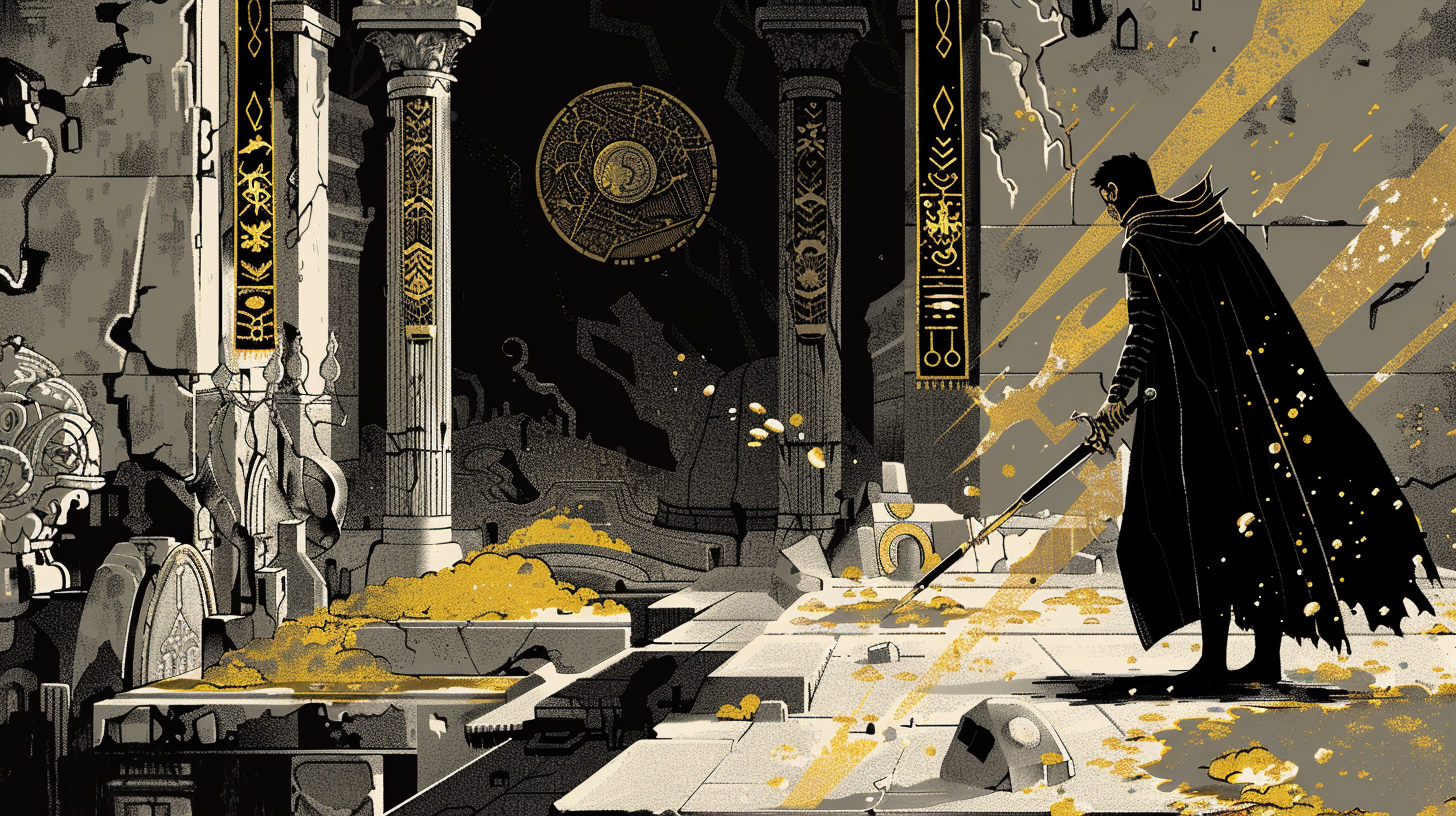
“I suppose he wasn’t thrilled to see us,” Wonderment said, massaging his elbow where Hob had grabbed him.
“I had just convinced him that he had never actually seen any prisoners other than myself,” the deposed king explained, “so he’s either questioning his own sanity or has concluded I’m a liar.”
“Why did you come back?”
“It’s better in here than it is out there,” Rafferty grumbled. “At least here we’re not skulking around like intruders in our friend’s house.”
“Your friend?” the deposed king asked.
“Yeah.” Wonderment sighed. “It turns out the new king, err… the imposter king, is an old friend.”
“You don’t say?” the deposed king asked. “Well, I just hope he’s as agreeable as you fine folk. I’ve never met him, you see, but being king here has a… corrupting influence.”
“I don’t know if I’d describe Charles as agreeable,” Wonderment mused. “But he has a good heart.”
“Like a friendly lunatic,” Rafferty interjected.
“At any rate,” the deposed king continued, “my trial is also scheduled for this coming morning. I hope he’ll see reason.”
“Charles isn’t a bad guy,” Wonderment said at last, “but I’m worried about him.” He did not feel entirely at ease with their collective fate resting in Charles’s hands. Sleep didn’t come easily. The layer of straw on the cell floor was thin. Occasionally, a rat would slink past. The three slept in fits and starts, and otherwise passed the time staring blankly at the walls.
Several hours after daybreak, Hob returned with two guards. He wouldn’t speak to any of them and, by gesture, communicated that they were to stand and follow. His demeanor had changed. Whereas the evening before, he had worn a ripped tunic, he now sported a luxurious robe that made him appear almost stately. His silence lent him an air of authority, almost of refinement. The change made Wonderment and the others uneasy, as though they were the punchline of a joke that had yet to be told. Hob’s companions were equally silent, but the clubs they carried were covered in rusted iron spikes, and these spikes also commanded a certain degree of authority. One of the guards handed them burlap bags, and the three dutifully donned them, obscuring their vision. Next, they were led up the same spiral stairs they had become familiar with the evening before, though this time, navigating was more difficult.
Their arrival wasn’t announced, though the groaning of a heavy wooden door indicated they had arrived somewhere important. There were voices. Then, a blinding light shone as the bags were removed. The three found themselves at the entrance to a vast hall. At the opposite end sat Charles, clad in a fine red cloak, high atop a wooden throne. He was the first thing Wonderment and Rafferty saw as their eyes adjusted. Rafferty grumbled. Between them were pews upon which men and women, clearly members of the elite, sat.
A shrill voice, wicked and piercing, called, “Next, his highness shall pass judgment on a dispute amongst the baker’s guild. He decrees that each party will give an account of their argument before a verdict is rendered. Please begin.”
A man in a brown tunic stepped forward. Judging by the streaks still scored through the grime on his boots, he had spent some time scraping mud from them with a stick.
“Your Royal Majesty,” the man stammered, “my name is Jeb, and I was told to get right to it, so that’s what I’ll do. I’m a baker. Baking is what I do. I bake loaves and buns. I have a shop in the town yonder, and as my pappy a’fore me, I make sale of the bread in a full loaf. That is, unsliced.”
“As per royal decree, on the sale of bread, unsliced, the taxes are collected on the basis of weight.”
Charles looked up at the ceiling. He pressed his fingers against the bridge of his nose. Though Wonderment and Rafferty had no idea, Charles had been adjudicating since first light. His role was painfully boring, but he couldn’t drop the act. Wonderment, on the other hand, was riveted.
He continued, “As is just. I’m happy to pay my dues to the crown. However, you see, I have a problem with that man there, and others of his ilk.” The baker pointed to another man wearing an almost identical tunic with an apron. His attire bore a white dusting, presumably of flour.
“That man there slices his bread,” the baker continued, “and sliced bread is taxed by the slice. When all is said and done, and the figures are figured, he pays less in taxes to the crown. That may be no great matter when we speak of a single loaf, but on the by-and-by, with every loaf he sells, he’s lining his pockets and driving me out of business!”
The baker, growing solemn, said, “In conclusion, your majesty, I ask that you acknowledge a loaf is larger before its cutting. We must appropriately value the part and the whole, so as not to give undue favor to those who slice and thereby diminish!”
Without pause, the second baker stood and shouted, “This man is a fool!”
A ripple of laughter passed through the audience. Charles, who appeared as though he hadn’t heard a word of what the man had said, quickly adopted a fake smile and motioned for the audience to calm down. The second baker cleared his throat.
“Beggin’ your pardon, Majesty. I am passionate, ya’ see.”
Charles nodded and waited for him to continue.
“I say that a loaf is larger after the cutting. You get more bread. More surfaces. More for the sharing. More for the buttering, when the butter ain’t rancid that is… It’s only fair that I do a bit better, make a bit more, am taxed a bit less, seeing as I’m supplying my customers with more.”
Then, in a knowing voice, he added, “The people need to eat.”
The second baker concluded, “I ask that you decree the taxes are good and fair. They are wise and just.”
Charles shot a bemused glance at Wonderment, then called in a booming voice, “So have you come before me to rule on rates of taxation or the largeness of bread before and after slicing?”
The two bakers looked at each other nervously. One of them whispered, “Both.”
Then, having reached consensus, they shouted, “Both!” in unison.
“Well then,” Charles replied, “I suppose we must define what larger means.” He stared at them, clearly challenging them to answer.
“Bigger!” the first baker shouted. Then, looking around and realizing the crowd wasn’t pleased with his answer, he gazed down at his shoes.
The second baker pretended to be deep in thought for a moment, then responded slowly, “More bread than before.”
Charles did not reply immediately. He let an uneasy silence settle over the room.
“Largeness,” Charles said at last, standing, “an interesting concept to be sure. We might think of the mass of an object, its quantity, or perhaps its efficacy in fulfilling its purpose.”
He began to pace lazily down the aisles. Where he passed, the courtiers bowed their heads in what Charles interpreted as reverence, but Wonderment suspected was fear.
Then, abruptly, he turned to the two bakers and asked, “Does the act of cutting add bread that was not there before?”
Both shook their heads no.
Then he asked, “Does cutting make more bread available?”
At these words, the second baker began to smile and nodded his head vigorously. The first baker scowled and kicked at the floor.
“When is the bread most capable of fulfilling its purpose? When is it most capable of becoming other things? When is its potentiality greatest?”
He watched as the two bakers racked their brains for a suitable answer.
“No?” he asked in a chiding tone.
After a moment, he said, “I am most inclined to assess the largeness of bread on the basis of potentiality.”
Then more quietly, “And clearly bread is in its purest, multipotent form before it is made. It is the raw ingredients that are, in fact, the largest.”
“We shall assess taxes on the raw ingredients,” Charles boomed, startling almost everyone, “and seeing as the ingredients are likely already taxed, taxes on flour shall be doubled.”
There was an audible gasp.
“Scribe, make a note of that,” Charles finished, “case adjourned.”
The room fell into a stunned silence. The bakers both nodded slowly, and then applause broke out. Charles glanced around nervously. As the applause grew and spread, he seemed to relax a little.
“I might have handled that differently,” Rafferty whispered to Wonderment. Hob kicked Rafferty in the back of the leg.
“Next!”
At these words, Hob pulled Wonderment and Rafferty forward and forcefully guided them to the benches that the two bakers had recently vacated.
Charles, who had returned to his throne, said, “Now. Treason is a much simpler matter.” Something about his voice made the hairs on the back of Wonderment’s neck stand up. Just then, a clanking noise near the back of the chamber caused Wonderment to whip around. One of the black knights marched along the central aisle, its cape flapping heroically despite the total absence of any breeze. It took a position at the podium opposite theirs.
“Now, Golem number 206,” Charles said, “your testimony please.”
It began in a grinding voice, “Your majesty, we apprehended these interlopers near the standing stones.”
The behemoth pointed at Wonderment, “This one came to our attention at the residence of the old sheep herd. He feigned ignorance of your majesty’s divine rule. We attempted to apprehend him then and there, but there was one of those… things you told us about… the… uh…”
“The glitches?” Charles asked.
“Yes, your majesty,” the knight continued, “there was a glitch, and he escaped.”
“I see,” replied Charles thoughtfully.
“And the other,” Charles said, winking at Rafferty, “why have you hauled him before me?”
The knight answered quickly, “This man stated that his majesty is a low-down, dirty goat’s bride. We don’t understand these words, but they are surely blasphemy!”
“That’s a lie!” Rafferty roared.
“Silence,” Charles boomed, “you will have your turn.”
Charles turned back to the knight, “Is this shepherd available to confirm your testimony?”
The heavy doors at the back of the hall swung open, and Seamus was led in by another knight. He looked very confused. Upon seeing Wonderment and Rafferty, his eyes widened. Seamus knelt before Charles and recited a short oath about telling the truth and otherwise being a good lad. Charles waved his hand in a circle, encouraging him to hurry up.
“Shepherd,” Charles interrupted, “Do you know these men? Tell me about them. Are they in fact blasphemers?”
Seamus stood. He was visibly trembling. Wonderment glanced to his side and saw that Rafferty was beaming.
Wonderment leaned over and whispered to Rafferty, “Why do you look so smug?”
Rafferty replied quietly, “I just might have left a little something in that old fart’s brain.”
Seamus began, “Your Majesty, I recognize the one there. That Wonderment fella, sure as Sunday pudding! Nice enough, he is. Said he came from some place called Resort, but he wears the strangest clothes. I mean, you wouldn’t believe that one’s attire. It’s all soft and silky, with these gleaming buttons. Not even a single hole or tear. You wouldn’t believe it… I tell ya.”
“Enough,” Charles said, “get to the blaspheming part.”
“Well, it’s the strangest thing,” Seamus continued, “that one there held a knife to my neck, forced me out to those old standing stones, and next thing you know – crack – that second fella falls right outta my head.”
The courtiers let out a polite gasp.
“He fell out of your head?” Charles asked. “Interesting.”
“Yes, your majesty,” Seamus continued, “I had this strange rattling around in my mind for a good two weeks, you see. I missed out on so much chorin’.”
Just then, Rafferty yelled, “Tell Miriam I said hi!”
Seamus whipped around and stared at Rafferty. His face went slack, then hardened into an expression that reminded Wonderment of Rafferty just before a fight.
“Listen here, you slug,” Seamus bellowed, “Miriam is sacred. I’ll kill any man who speaks ill of my Miriam or generally slanders my agrarian way of life. I know my flock by sound, by weight, and by how long they hesitate before coming in on an evening.”
Rafferty elbowed Wonderment and said, “I may have taught Seamus some new vocabulary.”
Then Rafferty loudly called, “Oh, the shepherd’s life can’t be that hard!”
Charles smiled and allowed Rafferty’s comment. He seemed to be enjoying the unfolding drama.
“My knowledge has been earned slowly, by repetition and attention. What I practice is not merely animal management, but a continuous negotiation between autonomy and control, freedom and safety, motion and constraint!”
Charles raised his eyebrows.
“The flock is not stupid,” Seamus bellowed, turning slightly red. “The flock is rational within a limited information environment. That means every intervention, every crook, shout, and silence, reshapes that system.”
He turned to the courtiers, “And yes, I will admit there is violence in shepherding. But it is bounded violence. Purposeful violence. Violence deployed in the service of long-term flourishing. Shepherding is the art of sustaining complexity without pretending it can be simplified. Governance without illusion.”
Sensing the gag, Wonderment chimed in, “Oh, bullshit!”
“And so you dismiss it; you sneer at it as primitive, pastoral, beneath serious thought,” Seamus continued, as if in a trance, “but you are not merely insulting a profession. You are attacking one of the oldest applied epistemologies we possess.”
Seamus paused to take a few breaths. He looked like a man who had just been doused in cold water, and he said, “I also muck the pens.”
Wonderment sniggered and gave Rafferty a cheeky grin. Rafferty smirked.
Charles laughed to himself, then said, “Well, I mean, wow. Thank you, Seamus. We’ll let you get back to your flock.”
“And now, my advisor, Sir Godwin the Thorough,” Charles said. “Do you have an opinion you’d like to share on these matters?”
A frail man in a dark cloak that Wonderment hadn’t noticed before sat at a table near the front of the room. His posture was hunched, and the outline of his frame through the fabric seemed oddly twisted. His reply was delivered in a cold, rasping voice, like the leaves of autumn carried along the ground by a chill breeze. “I advise that we give the accused the opportunity to address the court themselves, to hear what they have to say. And then we torture them, to be sure they’re telling the truth.”
“Yikes,” Charles said with a nervous laugh. Then, turning back to Wonderment and Rafferty, he said, “All right. It’s time for your song and dance.”
Wonderment stood somberly. Rafferty didn’t notice, and so Wonderment hit him in the arm. Rafferty stood as well. Neither knew where to begin, so Wonderment simply followed his first train of thought: “We left the resort, and we traveled further than expected. We wound up here, in a pig sty. But having learned that you, Charles, are king, we immediately sought out your advice.” With these words, he sat back down. Rafferty sat back down as well, clearly annoyed and wondering why he was required to stand in the first place.
Charles appeared lost in thought for a moment, and then he stood and raised his arms. He spoke solemnly, “Members of the court, it is true, I had recently been informed of ambassadors from this place called Resort. I was told to expect them. It seems they must have become lost in their travels. These men that you see before you are not blasphemers, but simple travelers, noble servants, seeking out our domain and my counsel.”
Another perfectly timed gasp rose from the crowd. Charles set his eyes on Wonderment and Rafferty. Then he threw his arms into the air and bellowed, “You have been wrongfully imprisoned, my friends, and you have my sincerest apologies. Please, as restitution for your troubles on our account, name a favor we can do for you – anything!”
The sudden presentation of this choice caught both Wonderment and Rafferty off guard. Charles’s pause and wide-eyed stare indicated that the time to make requests was now. After a confused glance passed between the two, Rafferty decided to try. “I’d like a warm meal, a bath, some comfortable clothes, and a large axe.”
“Ooo, yeah, nice…” Charles said with a smile, giggling at the mention of the axe.
“And you?” Charles asked, turning to Wonderment.
“I’d like information about the author,” Wonderment said, shooting a serious glance at Charles, as if to remind him that their theatrics had limitations. “Oh, and stop taxing Seamus,” Wonderment added, “he’s paid enough for one lifetime.”
“Right, right,” Charles responded. “Well, I have more cases to sit through. You two go, get cleaned up, and tonight we’ll have a feast in the great hall. You’ll be my guests of honor and so forth.”
Hob remained very confused as he let Wonderment and Rafferty out of their shackles. He was half-convinced that he’d be putting them back in shackles again before long. The other half was convinced the two were not real at all, and that some vast illusion had befallen the kingdom. Somewhat ironically, amongst those present, he probably had the clearest view of the entire situation. Wonderment and Rafferty were happy to be out of chains, and as they massaged their wrists, they allowed their prior misgivings about Charles to slip away. Charles had kept his word. They were then led from the hall by a small retinue of courtiers who seemed to speak constantly about nothing in particular. One moment, it was the weather; the next, the conversation turned to the accuracy of the village scales three townships over. Wonderment tried to follow these discussions for a time. The courtiers’ expressions and vocal tones suggested they found themselves enormously entertaining. Wonderment, however, could not trace a single thread of logic through the babble.
Rafferty was the first to enter a chamber finely adorned with gilded furniture, a large tub for washing, and a floor-to-ceiling mirror. An adjoining chamber, connected by a side door, had been apportioned for Wonderment. The chambers were identical except for the fact that a large and ornate battle axe was brought in and placed on the central table of Rafferty’s room. The two men separated for a quick bath and a change of clothes. Wonderment hadn’t realized how grimy he had become in the few short days since his arrival. The clothing he was given, when he emerged from the steaming water, was prickly. Its exterior looked fine enough, but the interior seemed almost unfinished. Nevertheless, the clothing fit, and the bright green doublet with shiny brass buttons gave him the appearance of a bard, or perhaps a wealthy merchant. A turquoise cap with a massive feather plume sat next to a pair of yellow hose. Wonderment put these on and finally felt like himself… well, a much itchier version of himself. He was just admiring a wood carving that resembled a crab when Rafferty burst into his room.
Rafferty held his new axe loosely in one hand and was pointing toward the door through which he had entered, yelling, “Wonderment, this utterly vexatious woman will not leave me be.”
“Oh, nonsense,” a sickly-sweet voice replied. A woman in a puffy red gown strode into the room after Rafferty.
Wonderment watched, amused, as Rafferty fled behind the circular table at the room’s center and circled it while the woman pursued him.
“Wonderment, I swear,” Rafferty yelled, “this one is wicked.”
“Come here,” the woman demanded. In her left hand, she carried a boutonniere of yellow flowers.
Wonderment started to laugh. Rafferty groaned angrily.
“Wonderment, she pushed that pin straight into my chest,” Rafferty explained, clearly panicked.
“Lies,” the woman sighed, “your fidgeting is what stuck you.”
“Wonderment!” Rafferty roared.
Wonderment chuckled. “Madame, perhaps you’d allow me to try pinning him.”
“Fine,” the woman said, and she handed him the boutonniere.
“Rafferty, come ‘ere,” Wonderment said.
Rafferty cautiously rounded the table, holding his axe in front of him as though he feared he might be assailed at any moment.
“A little testy, aren’t we, mate?” Wonderment asked.
“It’s just taking some getting used to,” Rafferty answered in a whisper. “I don’t think I’m settling in.”
“Easy,” Wonderment said. He swiftly pinned the boutonniere to Rafferty’s shirtfront, careful not to prick the skin.
“How’s that?” Wonderment asked the woman. She bent in close for an inspection.
“It’s askew,” she answered, “but heaven help me if I’m going to try to fix it. It’ll have to do.”
Rafferty pulled at the flowers for a moment but then gave up. Wonderment and the woman stared at him, and the silence grew awkward.
“Anyway,” Wonderment said, “who might you be?”
“Why, Lady Julianna, of course,” the woman replied. She curtsied. With uncertain ceremony, Wonderment accepted her hand and kissed it.
“Charmed,” he replied.
“See, you swine,” Lady Julianna screamed at Rafferty, “this is courtly etiquette.”
Rafferty swallowed hard and looked away, grumbling something no one else could understand.
“To what do we owe the pleasure?” Wonderment asked.
“I was instructed to be sure that you two are fit for an appearance before the royal entourage,” Lady Julianna explained, “and having done so, to lead you to the great hall.”
“Ah,” replied Wonderment. “And are we fit to appear?”
Lady Julianna wrinkled her nose. She inspected the fit of Wonderment’s garments for a moment. Wonderment stood awkwardly as she tugged at his sleeves and then ran a finger along the inside of his collar.
“This will do,” she answered after a few additional prods. “Follow!”
Lady Julianna turned to leave. Wonderment shot a glance at Rafferty, whose expression looked positively defeated.
“The axe stays!” Lady Julianna bellowed as Rafferty tried to take a step. Wonderment blinked when she presented him with her bent arm. Wonderment took her arm in the crook of his elbow. Rafferty rolled his eyes. As Wonderment and Lady Julianna proceeded out of the room, the sound of the axe cleaving into the surface of the table behind them echoed out into the hall. Rafferty’s stomping footsteps followed them through several twists and turns, and then into a massive chamber, even larger than the courtroom, filled with long tables. Servants in white smocks darted back and forth, laying plates and cutlery on the tables. A few were setting up candles. Across the room, to his surprise, Wonderment spied the deposed king. He slipped his arm out of Lady Julianna’s and headed straight for the man.
Before he proceeded three steps, Wonderment was intercepted by a man dressed in solid yellow with a thick beard.
“Sir Wonderment!” The man cried.
“Yes?” Wonderment answered, distracted.
“I wish to inform you that you performed admirably before the court today,” the man said. Then, with a sweeping bow, he proclaimed, “I am Sir Reginald. Some know me as Reginald the Defiler, though I assure you the moniker is unwarranted.”
“Um…” Wonderment began. Then he shut his mouth. Several other men and women in extravagant garb clustered around him. Lady Julianna cut through them and, once again, took Wonderment’s arm.
“He’s my charge,” she proclaimed proudly.
“Oh, Julianna,” another woman replied, “are you so desperate to charm our guests?”
“Yes,” Sir Reginald said, “leave some of him for the rest of the court.”
Lady Julianna glared at the man and hissed, “I will cut you.”
Sir Reginald gave a hearty laugh and answered, “Typical Julianna!”
“Sir Wonderment,” another man cut in, “please, humor us. Where do you come from? What news do you bring?”
Wonderment chuckled. In the back of his mind, he was deeply confident that this whole affair was temporary and that he would quickly find himself back in his own time. He supposed he might as well have some fun while he was here.
“Well, honestly, I come from another world,” he said. “It’s quite different. We have all manner of technologies, like artificial intelligence, and we’ve formed two adversarial political parties that can’t agree on anything.”
“Artificial intelligence,” Sir Reginald repeated, scratching his beard ponderously, “I suppose that’s common here, too. I am a great patron of the arts. I closely follow the latest works of our society’s leading artisans. And don’t get me started on politics.”
“Why’s that?” Wonderment asked.
“Well, you see,” Sir Reginald continued, “when your entire system is based on heredity and possession of absolute authority, it tends to amplify eccentricities. Our king, before Charles, was terribly fond of collecting insects. Can you believe such nonsense? He would put them in cases and just… look at them.” He finished with a shudder.
Wonderment shrugged. Sir Reginald continued, “Now Charles, long may he reign, is not without his own peculiarities. He seems totally oblivious to the fact that others can hear him, and he frequently sings poorly and at great volume. Some say, not me, of course, but some say, he won’t last long.”
“Is that so?” Wonderment asked.
“Well, I really can’t say any more,” Sir Reginald replied, “but the kings haven’t seemed to stay in place very long as of late. Must be something in the water.”
Wonderment swallowed this unpleasant piece of information. “So, you’re saying this place eats kings?” he asked.
Sir Reginald returned Wonderment’s shrug and excused himself. Feeling slightly off-center, Wonderment walked past the crowd of courtiers that had gathered, leaving them to interrogate Rafferty, and approached the deposed king, who seemed to be busying himself with a small cloth.
“So, you’re not in prison?” Wonderment asked.
“Define prison,” the deposed king suggested.
“I’d rather not,” Wonderment continued, “but what is it you’re doing?”
“Well,” the deposed king replied, as though in deep thought, “your new king Charles has made me his dedicated crown polisher, as a punishment.”
He continued, “Honestly, I find it rather amusing, and I admire his ingenuity, in a way. The absurdity that I, the true king, should have to spend my days polishing the crowns and ornaments of my replacement.”
“That is a little twisted,” Wonderment replied.
Their conversation was interrupted by a blast of trumpets. It was an unpleasant, brassy sound. A rhythmic drumming followed, along with the strumming of crude guitars, originating from a band of colorfully dressed musicians at one side of the hall. As if on cue, Charles waltzed through an entryway at the far end of the hall, swirling in circles and tapping his feet in a merry jig.
“Let the festivities commence!” he wailed.
In response, with a certain mechanical precision, the noble men and women in the room began to dance to the jubilant rhythm. It seemed as though they had all learned the same dance that Charles was performing, with varying degrees of retention. Wonderment felt strangely compelled to join in. Rafferty clearly had a similar feeling, his right foot tapping in time, as he glanced from side to side, as though checking to be sure he wasn’t under close observation. The dancing courtiers were organizing themselves into rows at the center of the hall, in the spaces between the long tables, and their turns began to synchronize. Before long, choosing not to join in made Wonderment and Rafferty more conspicuous, and so the two allowed themselves to be carried away by the music, which seemed imbued with some magical and captivating quality. Just as the two found positions at the end of a row, Charles addressed the room.
“That’s quite enough,” he called. The music immediately died. Charles cast himself into a heavy wooden chair at the head table. The courtiers, acting as if their positions had been assigned well in advance, made their way to their seats with the utmost efficiency. Before either had time to react, Wonderment and Rafferty were the only ones in the hall, aside from several servers, who remained standing.
“Oh, there you are!” Charles called. “Come, come! There’s a spot at the head table for you both. You’re my guests of honor!”
“I wish he’d drop the act,” Rafferty grumbled as they walked to the front of the room. Wonderment could feel the eyes of the courtiers on him, and with them, a pressure to remain in character. Perhaps he was an emissary from a distant land, come to establish a trade relationship, or some such fiction. Charles greeted them both warmly and had them take seats at his side. Then, he snapped his fingers and waved his index finger in a circle. The music resumed, and the servers began to deliver food and drink to the tables. The room grew noisy as a hundred voices launched into conversation simultaneously.
“Charles,” Wonderment began, “this whole plan of yours, you know, using the castle as a home base until we figure out what to do, is great, but it seems like we haven’t really had any time to talk!”
“We’re talking now,” Charles replied happily, “and we have so much to discuss!”
“Yes,” Rafferty chimed in, “like how we traveled through time, whether any of this is real, and what we should do next.”
“Exactly,” Charles said, “which reminds me, I haven’t yet told you about the results of our latest tournament! It was magnificent! I faced the champion, who remained standing after many rounds of combat. Would you believe that I bested him?”
“That’s great,” Wonderment answered, “but I really think we should turn our attention to the matter at hand. We came here to find the author, I think, but I’m beginning to feel like I’m losing the thread.”
“Just relax,” Charles said, “enjoy yourself! Tonight is about merriment! Tomorrow we can turn our attention to such matters. Now. Speaking of threads. Have I told you about the craftsmen in the village who weave clothing from spider’s thread?”
“No, Charles,” Rafferty barked, “we need to stay on topic!”
Just then, one of the servers set a large goblet down in front of Rafferty. His eyes widened and relaxed.
“As I was saying,” Charles said, “on my latest adventure I slew… I slayed… Is it slew or slayed? Anyway, I dispatched a roving band of fifty-odd bandits who were terrorizing the lands.”
“Uh-huh,” Rafferty replied. He had already finished half the mug, and another one had already been delivered. Wonderment had rediscovered his hunger and reached eagerly for some roast bird that had been set down nearby. Meanwhile, Charles was sipping at a soup. His expression appeared slightly disturbed. He motioned again. Sir Godwin the Thorough approached. Both Rafferty and Wonderment shivered. Unlike the rest of the party, Sir Godwin wore dark robes, and his thin, almost skeletal frame gave him a ghostly appearance.
“Advisor,” Charles called, “why is my soup cold?”
Without hesitation, Sir Godwin dipped a finger in Charles’s soup and swirled it in a circle.
“The soup is cold,” Sir Godwin hissed, as if confirming a theorem, “I suggest we torture the cook to ascertain why.”
“No, no,” Charles said, waving his hand, “that isn’t necessary. I’ll just have another drink.”
Wonderment leaned over and whispered to Rafferty, “This funny little court has teeth. I thought we were out of trouble. Now I’m thinking we stepped into the most dangerous room in the castle.”
Rafferty paid no attention to Wonderment. He had managed to attract the attention of a massive, lumbering man. Probably a knight, given the heavy belt and scabbard he wore. Rafferty had been flexing his arm muscles at a woman nearby, unaware that her husband would immediately come to defend her honor. Watching, Wonderment half-expected the situation to erupt into a violent duel, but it turned out the giant man had a decent sense of humor. He reached forward and squeezed Rafferty’s bicep playfully, and then flexed his own, which was far larger. Soon, the two had started arm wrestling, their exertions sending goblets and silverware crashing off the table. Charles watched the commotion for a time, but quickly grew bored. Wonderment suspected that he needed to be the center of attention.
“I have an announcement,” Charles called out, standing.
Someone in the crowd whispered, “Another one,” to the person sitting next to him, though Charles didn’t hear.
“Tonight, as special entertainment, I will be giving you a tour of my legendary treasure room!” Charles continued.
As Wonderment looked out over the crowd, he noticed several courtiers exchange worried glances. One drunken nobleman loudly proclaimed, “I’ve never seen it before!” He was quickly hushed by the woman sitting next to him. Charles rose from his chair and motioned for the others near him to do the same.
Charles might have looked majestic, Wonderment thought, were it not for their shared history, for the numerous quagmires from which he’d extricated the poor man. As such, the flowing green robe Charles wore, embroidered with golden thread, and the equally golden scepter he carried appeared to Wonderment as a cheap stage costume. The sight made him question when the curtain would lift, when the farce, so evident in every facet of their situation, would become apparent. Still, he followed Charles. A procession of noble men and women, fifteen or so, formed an orderly queue behind the jubilant Charles as he left the hall. Wonderment found his place among them and scanned for Rafferty. Rafferty strode merrily near the rear, arm in arm with the giant he had bested at arm wrestling, a mug in one hand.
“My dear friends,” Charles called, burping as he did so, “tonight you will see the wealth of the kingdom!”
A hurrah rose up in response to his words.
“You will gaze upon the mythical seeing stone of the wizard Tralbazar,” he continued, “wrested from his maddened grip. Who knows what power it still contains! So too will you see the famed gauntlet of Balthazar, rumored to still contain his skeletal appendage.”
Wonderment rolled his eyes. He tried to push his way toward Charles. In the process, he bumped against a noblewoman whose hair vaguely resembled a goose, and she gave him an icy glare.
“And of course you will find the finest paintings and sculptures from far-off lands,” Charles roared, practically skipping at this point. A murmur crept through the procession as they arrived at a massive door. The metal work on its surface was fashioned to resemble the heads of numerous beasts: lions, foxes, and the odd dragon. Two knights in black, without visors through which to see, stood guard. As the procession approached, the two knights, in unison, placed their hands on the hilt of their swords.
“Say, good sirs,” Charles said, “do let us in. By order of the king and all.”
Immediately, the two knights snapped to attention and drew their swords. They extended the blades outward overhead, then turned to face one another. Then, they marched toward each other, assuming the spot the other had previously occupied, and lowered their swords so that the tips rested on the ground. Charles walked between them and approached the door. From his neck, he retrieved a large skeleton key on a gold chain. The key fit easily into an ornate lock at the center of the door. When he turned the key, there was a moment’s pause. Then a quiet whir. Next, there was a rumble as giant gears, hidden somewhere in the walls, began to turn. The sound of metal grinding against metal echoed through the space, with several loud clangs. Wonderment felt as though this went on far too long to be purely practical. At last, one side of the door popped inward slightly. At this, the two knights turned, each placing one armored hand against the door, and pushed. It swung open.
Charles led the procession into the room. It came as no surprise to Wonderment that the room was completely empty. A single pedestal stood near the center, though it held nothing. There was dust on the floor, which had been brushed aside in several places, as though heavy bags had been dragged along its surface. Charles stood aghast. His jaw tried to move and quivered, but then remained set. “Someone has moved against me,” Charles whispered, to no one in particular. In one corner of the room, a piece of parchment was held in place by a dagger, embedded deep in a wooden support beam. Wonderment brushed past the immobile Charles and gazed at the drawing. On its surface, in charcoal, someone had sketched a dragon. The proportions were wrong, and the lines were uncertain, as though it were the work of a child. Sir Godwin the Thorough entered the room and narrowed his eyes at Wonderment.