Wonderment S1E1 - Shepherd’s Overwrite
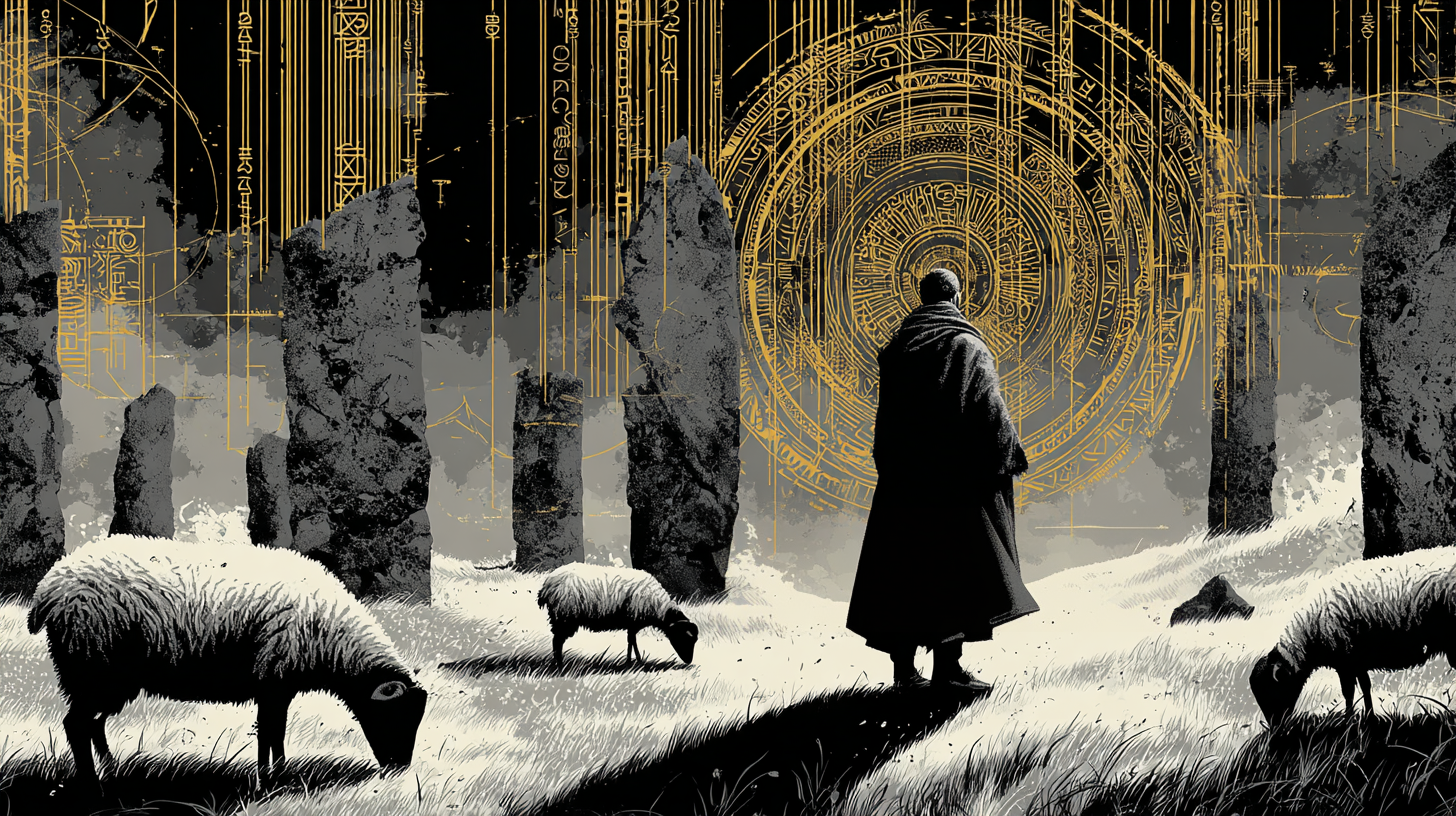
“Why are ya’ rollin’ with muh pigs?” demanded a farmer who might have stepped from Grant Wood’s canvas, pitchfork in absentia.
“Looking for the author,” Wonderment replied, “if anyone knew where this slop came from, it’d be the pigs.”
“No pigs here,” the man barked.
Heavy clouds materialized, erasing the sky. An insidious drizzle began. The gloom ambushed him. His eyes adjusted, and what he had taken for swine were in fact sheep, miniature mammalian clouds that bleated like faulty alarms.
“You let my flock alone,” the Shepherd bellowed.
“Useless lot, anyhow.” Wonderment muttered, flicking mud from his besmirched jacket.
“Where’d ye crawl in from, so? You drunk, or lost, or both?”
Wonderment approached the man, who had changed with the cloud cover, though Wonderment couldn’t say how.
“Well, I was just at a rather nice resort,” Wonderment answered, “lost ostensibly, but I’d prefer the dual affliction.”
A low brontide rolled from distant hills, too far to threaten, felt in the chest anyway. The rain intensified.
“Resort?” The man repeated, confused, then his eyes slid sideways, narrowing to predatory slits. A second later, he continued, “No matter. You’d better come inside. Thaw.”
“Did you hear me when I said that I wasn’t drunk?” Wonderment asked.
The man spat into the mud and waved his hand as though he were trying to swat a fly. He led Wonderment to a shabby hut constructed from ancient-looking stones. Inside: one small room, lit by a peat fire sizzling in a shallow hearth, dull orange through the smoke. The Shepherd thrust a wool blanket at him; damp, bristling, covered in dog hair. Then he set a kettle near the hearth.
“I’m still not drunk,” Wonderment complained. A deep chill was setting in. The fire’s warmth died before reaching him. Without speaking, the Shepherd gave Wonderment a tunic, which was much too large. Wonderment shed his muddy suit and belted the tunic at his waist. He looked like a monk. Wonderment dragged an uncomfortable wooden chair nearer to the fire, and the Shepherd thrust a steaming mug of fired clay into his hands.
“Tea,” the Shepherd said, “drink.”
Wonderment coughed. “God.” The brew was so bitter his tongue went numb.
“What exactly did you boil?” Wonderment asked. “A field?”
“Willow,” the Shepherd replied.
The Shepherd produced a bottle filled with golden liquid and poured some into his own cup.
“Something to soften it.” The Shepherd handed over the bottle. He continued, “Tell me where you’re from – this place called Resort.”
“It’s like a fancy house, or castle, that you pay to stay in. I was there with my friends,” Wonderment began, “Arjun, Charles, and Rafferty.” He chose his words carefully. They seemed to share no common ground. The Shepherd’s brow furrowed. A vein bulged. The conversation seemed to cost him physical effort. The muscles on the side of his neck tensed.
“I… I… Wonderment.” The Shepherd’s whisper. Then the man’s brow relaxed. His gaze softened. “You must be very wealthy then,” the Shepherd said, “to live in a castle.”
“I don’t live there,” Wonder said, “Besides, fiat currency is just an elaborate confidence scheme.”
“Confidence scheme?” The man repeated back to him.
“Well, I don’t know much about that,” the man continued, “I just live here with my sheep. I tend to them. I muck their pen and such. It’s a simple life, but it’s mine.”
After a moment’s thought, a quizzical expression passed over Wonderment’s face.
“How do you know my name?” He asked.
“Your name?” The Shepherd asked. “Don’t suppose I do. Which reminds me, we haven’t been properly introduced.”
The man stood, gave a gentle bow, and said, “My name is Seamus.”
“Wait a minute,” said Wonderment, before asking, “What’s my name?”
“You haven’t given it to me,” the man replied.
“What else do you know?” Wonderment leaned forward, growing intense. “Do you know about the gala? The heist? The porcelain pigs?”
Seamus’s eyes went distant, reading from a text that Wonderment couldn’t see. The clay mug fell from his hands, rolling across packed dirt. His hunched posture straightened. Seamus lurched forward and grabbed the collar of Wonderment’s tunic.
“You made it too, thank God!” Seamus’s voice had changed to one that was familiar, “I’m stuck. I overwrote someone. These words in my throat aren’t mine. Programmed routines: feeding, mucking, and market.”
“Rafferty?” Recognition hit. The voice was unmistakable.
Seamus collapsed back into his chair and placed a hand on his forehead. He moaned.
“It’s a simple life,” Seamus continued, wincing, in a voice no longer that of Wonderment’s friend, “They say in church that the meek shall inherit the Earth, but that’s about all the inheritance I can hope for.” His laugh turned into a wheeze.
“Hold on,” Wonderment said, “Rafferty. I know that’s you.”
“No Rafferty here,” Seamus replied, shaking his head, “just old Seamus. Oh, and my mutt here.” Seamus nodded toward a dog in the corner, snoozing.
A bang came from the hut’s thin door. Then pounding.
“Oh no!” Seamus moaned, “They’re back.”
“Who’s back?”
The dog in the corner lifted its head and began to growl.
Seamus motioned for Wonderment to stay where he was and scurried over to the door. Wonderment turned to watch over his shoulder. Seamus opened the door, and a hulking figure blocked all the light from the outside. A few words were exchanged, and though Wonderment couldn’t discern them, the newcomer’s voice was chilling. A moment later, Seamus stepped outside. The dog sprang up and walked to Wonderment’s side. It began to whine. Wonderment let out a frustrated sigh. He set down his mug of bitter tea, threw down the wool blanket, and thrust his feet back into the dress shoes he’d arrived in.
He blinked as he slipped out of the gloomy abode. Seamus stood a short distance down a muddy lane leading to the road. Near the gate of a rail fence stood two massive figures in lacquered black armor. Their faces were obscured by bascinet helms, and ragged crimson cloaks flapped behind them. On the capes, Wonderment spied an emblem that resembled a black boar’s head. A third knight fastened the bridles of three horses to a fencepost, standing back. Wonderment walked forward cautiously.
“I paid last month!” Seamus begged, “Three head, on time, like always.”
“It is a new month,” replied one of the knights, it was impossible to discern which, in a tone that sounded like a whisper amplified a thousandfold.
“Surely you do not defy the King’s tithe,” the knight hissed.
“No, no.” Seamus sniveled, “Alright, I will bring three head to market on the morrow.”
“Six,” hissed the knight, “for your insolence. Today.”
Seamus cast a wary eye at the threatening cloud cover. One of the knights took a menacing step forward and raised an arm. Seamus flinched.
“Who’s King here?” Wonderment called, approaching more quickly now.
The knight in the rear finished tying the horses and began to approach, yet it made little progress. The third knight couldn’t decide where to stand. It walked one way, and then in the other, before turning again. This looping continued while a different knight answered, “All bow before the King of the realm. To pretend not to know of our King is sacrilege.” An armored gauntlet rested on the hilt of a long sword.
“How far does your King’s domain span?” Called Wonderment.
The knight unsheathed its sword. It pointed the sword first at one horizon, and then to the other.
“Ignore him.” Seamus pleaded, “He’s out of his head. He doesn’t know what he’s saying.”
“Silence,” commanded the knight holding the sword before whisper-shouting, “Apprehend this blasphemer!”
The knight in the rear drew a sword, held it aloft, and charged in Wonderment’s direction. The fence stood between the two, and the knight struck it hard, bouncing backward. The knight repeated the same action, slamming into the strong bows of the fence’s rails. Wonderment watched, confused. The knight then walked forward, sword aloft, and pressed its chest into the fence while continuing to march – as though it might push the fence over. The ground was soggy, and the knight’s feet slipped, providing no traction. This continued for almost a minute, during which the knight took step after step, unable to advance.
Then the knights all sheathed their swords in unison, as though they had silently decided he wasn’t worth the effort. The knight in the lead said, “Six head. Today.”
“Yes, of course,” Seamus replied with a bow.
The knights mounted their horses and set off in a rush.
“Those knights seem like trouble,” Wonderment said as he walked with Seamus back toward the shack.
“They keep demanding more,” Seamus sniveled. A look of grim determination came over him, “But there is no choice. We’ll bring the sheep to market.”
“Ey,” Seamus called to the dog, whose head was poking through the open door, and then he snapped his fingers three times. The dog rocketed out of the dwelling and into the sheep pen, where it began to run in tightening circles around the flock. Wonderment followed Seamus to the pen’s gate and watched him select six small clouds from his flock.
“You really let them walk all over you.” Wonderment replied, “Rafferty would never do that. Maybe you aren’t him after all.”
Wonderment thought for a moment. He felt lucky to have avoided the altercation with the knights, and he wasn’t eager to try his luck again. Yet the thought of setting off on his own along the muddy lane with no bearing seemed ridiculous. Perhaps, he realized, the town would provide him with clues as to his whereabouts.
“Fine.” Wonderment replied, “I’ll join you.”
Seamus shrugged. They set off. Barking. Bleating. Mud. Seamus’s dog required no instruction and kept the minor division of sheep marching along behind them. At forks in the road, the dog would run ahead of them and take a seat a short distance down the branch of the road they should take. It was clearly guiding them. Trudging through the soft mud was arduous work, and Seamus marched along mechanically like a man heading to the gallows. There was silence.
Wonderment turned to Seamus abruptly. “Rafferty!”
Seamus stopped walking mid-stride. His head turned toward Wonderment in a series of jerks, as though the muscles of his neck were protesting the movement.
“Wonderment,” hissed Rafferty’s voice, “I’m trapped.”
“Hah, I knew it was you,” Wonderment bellowed. “Why are you wearing someone else’s skin?”
“I… merged,” Rafferty sputtered in choked phrases, “feels… like code.”
“How do you mean?” Wonderment asked.
“I’m a process, in the background.” Rafferty croaked, “Still running, low priority, with a second high-priority executable sharing my memory space. When I reach for a thought, the pointer jumps, and something else runs.”
“What? Asked Wonderment.
“My stack frames are filling with someone else’s local variables.”
“I don’t know what any of that means,” answered Wonderment. “Has Arjun been teaching you to code again?”
“No time,” Rafferty grunted.
“I’m losing… myself… again,” Rafferty managed before Seamus interrupted, “It’s a simple life, herding sheep, but it keeps me busy. Not much else to do, I suppose.”
“Rafferty,” Wonderment said sadly.
“Nope. Still don’t know no Rafferty,” Seamus answered.
They arrived in town and, shortly after passing through the outermost ring of wooden buildings, came upon a market. It was loud, filthy, and cruel. Oily smoke hung in layers. Animals and merchants cried out. Mud rose past Wonderment’s ankles, his leather shoes useless against it. Nearby, two men in ripped tunics argued about the price of grain. Spit flew with every shout. They passed a butcher’s stall, and the pungent aroma of limp meat on hooks assaulted their nostrils. With robotic precision, Seamus’s dog ushered the six sheep they had brought into a pen near the center of the market. A scrawny man with thick spectacles made marks on his parchment.
“The King’s tax,” Seamus said to the man, who nodded glumly.
“Three head sheep,” the man said back.
“Three?” Seamus roared, “That was six, you oaf!”
“Oh. Indeed,” the man admitted, straightening his glasses, “but how am I to know that they’re all yours?”
“Well, I brought them,” Seamus bellowed.
“I suppose so,” the man answered, “but that doesn’t mean they’re yours.”
“Whose would they be?” Seamus asked back.
The man scratched his chin, “I don’t know.”
“They’re mine, six sheep, all of them,” Seamus continued.
“You might have just said that,” the man replied.
“Why did you assume three?” Seamus asked, still enraged.
“It seemed like a reasonable enough number,” the man responded.
“Six,” Seamus said, jabbing the man’s parchment with his finger, “you put that down.”
“Alright, alright,” the man answered. “Don’t get your dander in a hurry.”
Seamus spat into the mud near the man’s feet and turned to go. Wonderment followed, but something was nagging him. The market had suddenly gone silent. Wonderment glanced around. The merchants and farmers stood upright, sullenly, all quiet as though they were waiting for something. A metallic clanking became audible over the bleating of the sheep in the pen. Wonderment scanned the area and spotted two of the same black knights that had harried them earlier, stomping around on the far side of the pen. They strode up to a merchant’s stall and appeared to engage in conversation, their hands on the hilts of their swords. In seconds, the merchant had pulled a wooden box from beneath his stall and was handing over coins.
“Come on. We can avoid them in the tavern.”
Wonderment wasn’t eager for another confrontation, and he followed Seamus without complaint. They passed through narrow lanes leading away from the market until they reached a drab building with a wooden sign resembling a hare’s head. Several grave men stood outside, smoking but not talking. Seamus entered, followed by Wonderment.
The pub was dark and noisy. Wonderment kicked his shoes against the threshold to try to get the mud off, with little success. Not that it made much difference, as a thick layer of grime covered the flagstone floor. Fires crackled in two hearths on either side of the room, and a surprising crowd yammered happily at low-set tables filling the central room.
“Oy, Seamus!” The bartender, a thin, older man, called from behind the bar. Seamus waved and headed over. There was little room at the bar, just a single open spot, and Seamus slipped in as though it had been reserved for him. Wonderment stood awkwardly behind as the bartender addressed Seamus.
“Seamus, my old friend, would you care to have a look at my wares? Warm food to drive away the cold? A cold drink to cure the sorrow?” The bartender asked. Seamus just nodded, and the bartender poured him a brown ale.
“Anything for your friend there?” the bartender asked, “a draught to cure the blues.”
“Oh,” answered Seamus, as though he’d forgotten Wonderment’s presence entirely.
“Your strongest liquid courage, please,” answered Wonderment. The bartender muttered something Wonderment couldn’t understand and poured him a mug of the same sticky brown liquid.
“Jameson,” Seamus said to a short man at his side, “Can you make some room for this fellow here?”
“But this is my spot,” Jameson protested. A nasty scar split Jameson’s cheek.
“I know that’s your spot,” Seamus replied, “but do us a favor, would you?”
“I don’t want to,” replied Jameson, though his brow furrowed as if he were seriously considering the proposition.
“Listen, mate, it isn’t every day I ask you to make a little room,” Seamus continued.
“Can’t you do me this favor?” Asked Seamus. Then he tried bartering, “Next time you bring in one of your mates, or heaven forbid, a fine lass, I’ll happily make room.”
“But I don’t ever be bringing along no mates nor lasses,” answered Jameson.
“I know,” said Seamus, “and maybe you should have a pondering on that.”
“Erm,” grumbled Jameson, but then, without another word, he sauntered off toward an open seat nearer the fire.
Wonderment took the open spot and grabbed his drink. The brew was bitter, but it didn’t make his tongue numb in the way Seamus’s tea had.
“Are there any writers around here?” Wonderment asked Seamus and the bartender, who still faced them, “You know, like a historian, a poet, some kind of chronicler or storyteller?” The pub fell silent. Every face turned toward him. The pause lasted for several moments before a drunken man, who kept both hands on his mug as if it might choose to flee, started coughing. His fit continued, and he began to wretch uncontrollably.
When his hacking subsided, he muttered, “’scuse me.”
The man cleared his throat and began speaking, “No storytellers nor poets round about, friend, and you’d be wise not to enquire about whys.”
“Why’s that?” Asked Wonderment immediately. Seamus clicked at him in distaste.
The man continued as though he hadn’t heard Wonderment, “The stories we have come to us from our elders, when we were small like see, and there’s good enough.”
“I might adds,” the man said, “if you’re inclined to the asking, that all them tales been scrawled out on the standing stones out cross the moor there.” He waved a crooked finger in the wrong direction.
“Standing stones?” Wonderment asked Seamus.
“Luke, ya crazy bastard,” Seamus called out, “mind yer beer.”
The drunk chuckled and turned away.
“So?” Asked Wonderment.
“The standing stones are a sort of… how do you say?” Seamus asked.
“Monument?” Asked Wonderment.
“No… like a crone’s tale,” Seamus continued, “they’re just a landmark that people can’t keep from minding. You see, when all’s you do is minding the sheep and mucking the pens it’s easy for the mind to wander.” He laughed and sipped his beer. A smirk crossed his face, and Wonderment thought the drink must be starting to have an effect.
“Are there really stories written there?” Wonderment asked.
“Well, there are some carvings, that’s a sure thing,” Seamus answered, “but they don’t rightly mean anything. Just some lad with a chisel and nothing better to do if you ask me.”
“Take me there at once,” Wonderment ordered.
“Keep your head in front of your feet, laddie.” Seamus downed the rest of his pint. Wonderment grumbled and turned back to his own drink.
Seamus then gasped and jerked forward, toppling his mug. The bartender noticed the empty mug and approached. “Seamus, my old friend, would you care to have a look at my wares? Warm food to drive away the cold? A cold drink to cure the sorrow?”
Seamus recovered, thrust the mug at the bartender, and said, “Another.” His voice had changed.
“Finally!” Rafferty groaned, “Ugh, it’s so good to have that peon outta my brain for a second.”
“You’re back,” Wonderment exclaimed in surprise.
“Yeah. Something about the drink makes it easier to resurface.” Rafferty continued, “God, I can’t stand this.”
“It’s bad then?” Wonderment asked.
“Bad,” Rafferty grabbed his refill out of the bartender’s hands. “It’s misery. The claustrophobia. I can’t even describe it.”
“Please don’t leave me in here,” Rafferty begged. Wonderment’s stomach knotted. Rafferty was always the confident one, the unshakeable one.
“I can’t be stuck as this background character any longer,” Rafferty continued, “please get me out!” Rafferty grabbed Wonderment’s sleeve. He cringed, as though he’d developed a terrible headache.
“Those standing stones,” Rafferty managed, “there’s something about them. I don’t know how I know, but I can feel it. We need to go there.”
“That’s not going to be easy,” Wonderment replied. “Seamus only cares about his sheep. I can’t imagine convincing him to take me there.”
“The contemptible fool,” Rafferty shook his head, “you might need to force me to go. But you have to. I can feel it. The plot needs us to go there.”
“I’ll try,” Wonderment said, sipping his beer. Rafferty gulped the rest of his. The bartender, still watching, said, “Seamus, my old friend, would you care to have a look at my wares? Warm food to drive away the cold? A cold drink to cure the sorrow?”
“What’s this guy’s deal?” Wonderment asked. “He keeps repeating the same damn thing.”
“All of them do,” Rafferty said hoarsely, “they just loop through the same phrases, again and again, it’s hell.”
“And I do the same,” Rafferty moaned, “I just drone on and on about tending the sheep and mucking the pen. Over and over again. Everyone I meet. I tell ‘em all. I can’t stop.”
Rafferty shook his head. Tears came to his eyes.
“And that reminds me,” he said, his voice losing strength, “you should really consider the shepherd’s life. It’s a simple one, but it’s mine. I tend the sheep and muck the pen, but that’s good enough for me.”
The next morning, Wonderment had made his decision. He held a knife against Seamus’s throat. “You’re taking me across the moors,” he said bluntly. Seamus wearily got to his feet, his understanding immediate, likely because this wasn’t dissimilar to the arrangement he had with the knights. They stepped out into the morning gloom, clouds overhead making it evident that day wouldn’t break. Mist drifted about their ankles as they trudged over the rolling hills, the soft ground sucking at their boots. Seamus’s dog led the way, as it had led them to market, oblivious to the tension that existed between the two men.
“I won’t finish my chorin’ today,” Seamus said angrily. “Miriam’s got to be worried sick!”
“Miriam?” Wonderment asked.
“Miriam,” Seamus replied, “my prized ewe. She gets upset when I’m away for too long, you know.”
“Miriam is going to have to manage,” Wonderment replied, “step lively now.”
“I don’t see why you’re on about these old stones,” Seamus tried again, “nothing out here but bog and ghosts.”
On several occasions, Rafferty seemed to break through, but only briefly. Seamus would get a wild look in his eyes, look at his knife-wielding companion, and gasp, “Wonderment!” Another time, he choked out the words, “en route to objective.”
Each time, Wonderment would ask, “Rafferty?” But no reply ever came. Seamus returned, more worried about his chores than ever. Wonderment grew frustrated by these glimpses of reality and began peppering Seamus with questions.
“Wasn’t it funny how we got so obsessed with that pig statue?” Wonderment asked.
“Pigs are fine animals, fine, I tell you,” Seamus replied, “but inferior to sheep in the ways that matter. I haven’t much of a taste for pig’s milk.”
A bit later, after another flare-up, Wonderment said, “What do you think happened to Charles and Arjun?”
Seamus gritted his teeth and answered, “There’s… something… about the… farming life,” but stopped mid-phrase.
Wonderment gave up and tried to enjoy the scenery, but it was unsettling. The fog billowed impossibly – all roiling and undulating one moment and then static, almost two-dimensional in the next. As he watched, the stalled fog would stutter and then resume moving too quickly, as if he were trying to stream a movie over a terrible broadband connection. There were objects in the distance, but they were impermanent and in constant flux. Wonderment spied a tree through the fog, near the crest of a hill, but when he looked back, there was only a boulder. When he turned away, in the corner of his eye, he saw the shape of a person, which vanished when he turned back.
“I’m… scared… Wonderment,” a blend of two voices said to him, “I think there’s more shepherd left than me. I think you should just leave me. Let me get back to my flock.”
Wonderment slapped him. The dog barked.
They continued along a narrow dirt trail that cut through the lush green foliage, and Seamus said, “The stones are just up here.”
At that exact moment, there was a pounding of hooves and the clank of metal. Behind them, through the fog, the silhouettes of riders on horseback came into view. Seamus wheeled around and exclaimed, “Let’s just turn ourselves in!” He managed to walk back the way they had come for several strides before Wonderment caught him, reminded him there was a knife against his back, and turned him back around to the stones, which were now visible near a patch of trees in a narrow valley. The path led directly up to the stones, which were ringed by a short rock boundary. The clanking and pounding behind them grew louder, and Wonderment could have sworn he heard meaningless whispers on the breeze.
The stones were massive, age-worn things, half-sunken into the peat. At their feet, a variety of offerings and cheap charms had been left. There were small, extinguished candles and unopened bottles of alcohol. The scene suggested a party about to begin, or one abandoned mid-preparation. They crossed the low rock wall encircling the stones, and immediately Rafferty broke through, “My God, that feels so much better! We’re here.” The dog took a seat near the wall but refused to go any further.
“That’s good to hear,” Wonderment said, “we need to hurry, the knights are behind us.”
Rafferty nodded, and Wonderment let the knife drop to the ground. Rafferty moved carefully to the low point where the stones were arranged in an oblong circle. He exhaled a sigh of relief, and the exposed skin of his hands began to radiate a soft white glow. The stones groaned and popped in the way a lake sings as it freezes. The runes on the stones, mostly hidden by moss and debris until now, began to glow red, like hot iron. Wonderment watched in awe, unsure whether he should pull Rafferty away or encourage him to keep going. As Rafferty drew nearer, the white glow became more intense, and his face, still that of the Shepherd, began to shimmer. He passed behind the first stone, into the center of the ring, knocking over several candles. There was a sizzle, like meat thrown into a hot skillet, and Rafferty’s feet left the ground. He hung motionless in the air for a moment. A loud crack pierced the stillness, and the dog barked.
Two bodies appeared where one had been. They dropped like sacks of grain to the soft peat. Seamus recovered first, and he crawled on hands and knees out of the stone circle. “Where am I?” he asked Wonderment.
Next, Rafferty reappeared, on shaking legs, and approached Wonderment. “I can’t believe that worked.”
“Are you feeling alright?” Wonderment asked, amazed that his friend was free.
“Yeah,” replied Rafferty, “but I’m not sure I’ll ever fully get Seamus out of my brain. The sheep still call to me.” He laughed deeply, a sound that Wonderment found comforting and seemed the first normal thing he’d experienced since he arrived. Rafferty clasped his hand and then embraced Wonderment.
Seamus yelled, “Miriam, I’m coming,” and he darted off into the heavy fog. Seamus’s dog whined and scurried away. The hoofbeats resumed. Loud. Wonderment and Rafferty scanned the area but saw only fog. Hoofbeats. Then silence. There was a clunk of armored legs. Silhouettes appeared in the mist, just beyond the wall. The cloaks worn by the knights snapped in a wind Wonderment and Rafferty couldn’t feel. They moved closer, in silence. A moment later, there was the clanking of armored bodies, but it was out of sync, like a broken audio track. The fog thinned slightly, and Wonderment saw the horses, waiting just behind the silhouettes. The beasts were impossibly still. One levitated several inches above the ground. Wrong.
In the next moment, Wonderment felt a powerful metal arm around his torso. He tried to cry out, but the force of the grip squeezed the breath out of him. He was hoisted, then thrown flat on his back. He saw Rafferty flanked by two black knights, their helmets lacking any gaps through which a person could see. Rafferty struggled against these automata, but he too was overpowered and thrown to the ground. Another knight stepped forward, and Wonderment felt a mighty gauntlet forcing his neck toward the first knight. It unfurled a scroll.
“You are hereby seized for narrative defiance. By order of His Majesty, Keeper of the Script, you will be brought before the King for trial.”
A sack was pulled over Wonderment’s head. It was tight, rough, and moist. Breathing was almost impossible. His world tilted, and then he felt himself being thrown over a horse. Each stride crushed his guts. He felt ill. Hoofbeats thundered like pounding on a typewriter.